




Yoshio Nakajima
Contemporary Ceramic Artist
Artist Statement
The world is always in flux. And the more certain something seems, the more it harbors uncertainty within.
The world is filled with contradictions — and nothing exists alone; all things manifest through their opposites. — light and shadow, man and woman, truth and fiction, creation and collapse. Guided by the ancient philosophy of Yin and Yang, I create ceramic works that embrace both fragility and permanence.
In some of my creations, the glaze metamorphoses into bubbles — delicate, fleeting forms that, through fire, become fossilized onto the surface of clay. This process captures the tension between the ephemeral and the eternal.
For me, everything begins and ends with the earth. Clay holds the memory of origins, and through fire, it returns to a new state — never the same, yet never lost.
In an era where history and information are often distorted, I turn to materials — the honesty of soil, fire, and glaze — as a way to express a contemporary atmosphere. My works are both fragile and resilient, layered with hidden spaces, echoing the uncertain, floating world we inhabit.
Each bubble, each fissure, each layer speaks quietly of collapse, hope, and the possibility of regeneration.
From an early age, I have viewed the world slightly differently — questioning what others accept, sensing contradictions beneath the surface.
This perspective, shaped by my belief in the interconnected forces of Yin and Yang, flows naturally into my work.
I trust the earth, fire, and glaze to reveal invisible connections — between fragility and strength, chaos and clarity, dissolution and rebirth.
Through ceramics, I seek not only to create objects, but to express the delicate, hidden structures of existence itself.
Awa — Fossilized Moment
Awa captures the moment when boiling minerals create ceramic space.
It is a material phenomenon where glaze expands, bubbles, and forms structure within clay.
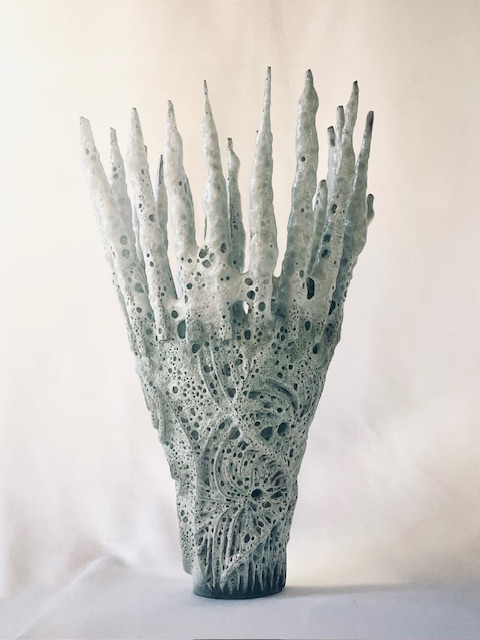


Loving what Is being lost.
My practice is not about applying glaze as decoration, but about witnessing the moment when matter begins to act on its own.
My practice begins with the idea that glaze can be more than surface decoration — that it can become the core of expression itself.
When I first encountered the lava-like glazes in the works of Lucie Rie and Adam Silverman, I was drawn to their presence. They felt less like form and more like phenomenon — like clouds or exposed geological strata carrying the weight of time.
Through repeated experimentation, I eventually learned how to reproduce similar lava-like surfaces. Yet at that moment, a question emerged:
Had this phenomenon truly been digested beyond “texture”?
This led me to separate bubbling from the metaphor of lava and to approach bubbles as a state in themselves. Without assuming a final image, I began re-examining each element involved in ceramics — clay, temperature, time, gravity, material composition, glaze application, and thickness — listening to what was occurring inside the kiln.
After nearly fifteen years of sustained inquiry, toward the end of 2023, the material responses I had been working with finally cohered into a structure.From this understanding, Awa emerged — a phenomenon in which materials generate space through bubbling and expansion.
Unlike a surface coating, Awa exists as a layer generated between material and space. Depending on conditions, the bubbled layer can exceed 3 cm in thickness, encompassing multiple states — from dense and rigid to forms as fragile as meringue.
In some works, the extremely thinned cellular walls subtly resonate and emit a faint sound when touched.This is not an intended effect, but a phenomenon arising from the material structure itself.
What matters to me is not eliminating what cannot be fully controlled, but sensing how far it can be released. The bubble is not a fixed form; it exists at the boundary between generation and collapse. I test how much instability ceramic material can endure.
This approach is less about technical novelty than about gently unsettling the notions of “completion” and “form” within ceramics. I feel I have only just begun to reach the point where glaze itself stands as the central subject of the work.
At present, I present works centered on Awa through juried exhibitions in Japan and abroad, continuing to explore how far this phenomenon can be opened. It is both an expansion and a sustained, quiet act of observation.
▶Listen to the sound of glaze transformed into foam
Since pottery was born in the Jomon period, has there ever been work with these characteristics?Not crazing after firing—months-old ceramic that resonates when touched.
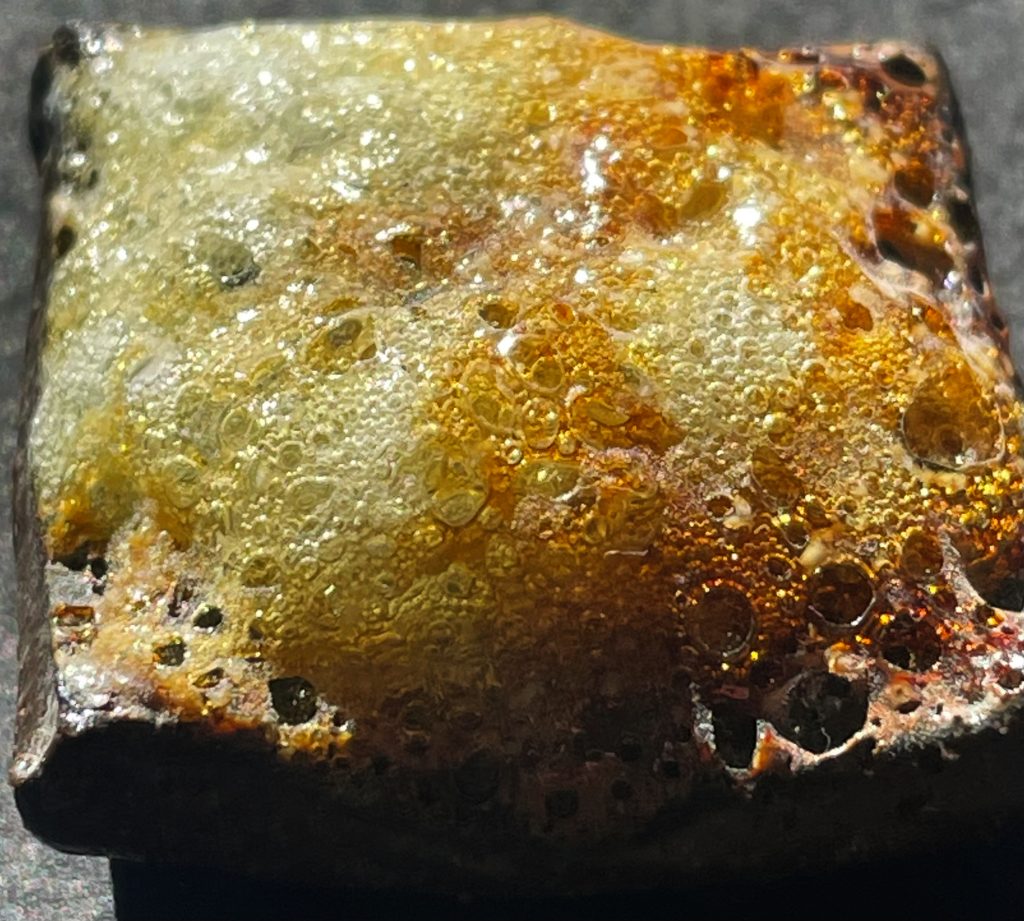
Frozen Foam
Thin-walled cellular structure—when touched, it resonates, crackling like carbonation.The phenomenon of foam, in ceramic.
Characteristics
– Sight: Amber translucence, light-passing thin walls
– Touch: Delicate foam structure, ultra-thin cell walls
– Sound: Carbonation-like crackling when touched
– Structure: Authentic foam layering and internal cavities
– Phenomenon: Ephemerality made visible and audible
– Technique: Unique method developed through 15 years
CV / Biography
Name
Yoshio Nakajima
Born
Shizuoka, Japan
Based in
Ito, Shizuoka, Japan
Education
- Hosei University, Faculty of Business Administration, Tokyo, Japan
Professional Background
- Encountered ceramics during student years at a pottery studio in Tamba, Japan
- Worked in the real estate industry before pursuing ceramics independently
- 1998–2006 — Self-taught research and exploration in ceramics
- 2006 Founded MONO FACTORY
- 2017 Relocated studio to Ito, Shizuoka, Japan
Selected Exhibitions
- 2025 The 4th Makurazaki International Art Award Exhibition, Japan
- 2025 The 51st Shizuoka Prefectural Crafts Exhibition, Japan
- 2024 The 53rd ZENTO Exhibition, Japan
Awards
- 2024 Encouragement Award, The 53rd ZENTO Exhibition
- 2015 Excellence Award, Lucie Rie Ceramics Competition
Studio
- MONO FACTORY, Ito, Shizuoka, Japan
Studio & Practice
Working from my studio in Izu, Japan, I engage with clay, glaze, and fire as active participants in the process of making.For me, making is less about imposing form than about spending time observing the behaviors that emerge from within the material itself.
In my practice, glaze is not treated as surface decoration but as a structural element.Through layered applications and the emergence of bubbles, spaces are formed within the work—internal spaces that cannot be touched, yet remain perceptible.
My practice centers on negotiating the boundary between control and contingency:determining how far to intervene, and at what point the material must be allowed to act on its own.
Through ceramics—a material that remains only partially understood even within contemporary science—I reconsider the relationship between material, body, and time in a contemporary context.